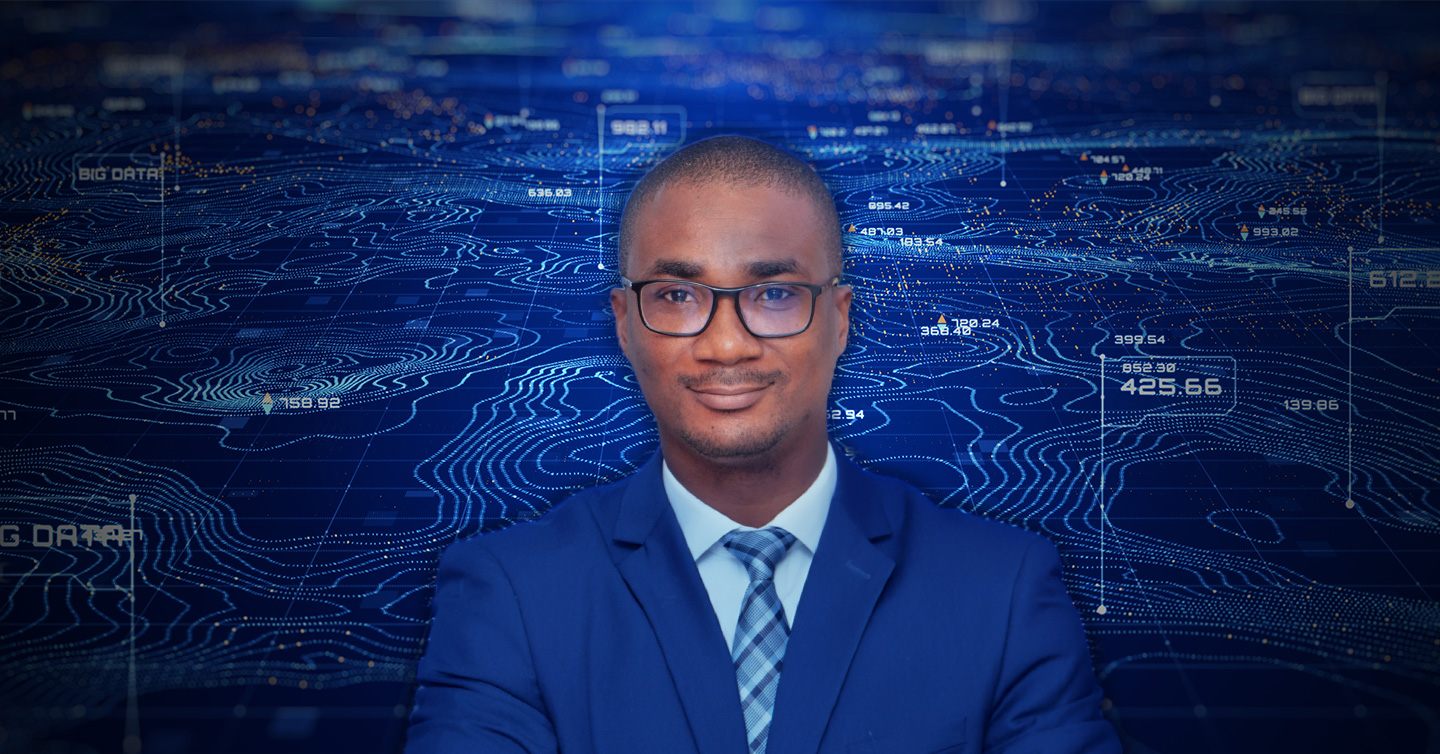
From a mathematics student who stumbled into geospatial science almost by accident to now leading Côte d’Ivoire’s national mapping authority, Fernand Bale’s career has been shaped by curiosity, collaboration, and a belief that geographic information can improve lives. Today, as Director of CIGN within BNETD and a former Co-Chair of the UN-GGIM Committee of Experts, he stands at the center of a rapidly evolving geospatial landscape – one where standards, data sovereignty, and digital innovation are transforming how nations plan, build, and govern.
In this conversation, Bale reflects on his journey, the growing role of geospatial infrastructure in Africa’s development, and how partnerships with organizations like OGC are helping accelerate capability, access, and global alignment.
Your career has evolved significantly within Bureau National d’Études Techniques et de Développement (BNETD), leading now to your role at Centre d’Information Géographique et du Numérique (CIGN). How did geospatial science become part of your path, and what has kept you committed to this work over the years?
I have a background in mathematics, and I stumbled into the geospatial field almost by chance when I was admitted to the École Nationale des Sciences Géographiques (ENSG) in Paris. But once I discovered the power of geospatial data and services, I was completely hooked.
What has shaped me most is realizing that geospatial information isn’t just about maps and coordinates – it’s about connecting with people and working together to solve real problems that make a difference and support sustainable development. That human element, that collaborative spirit, has been the driving force throughout my career at BNETD.
From being a Research Analyst to now leading Côte d’Ivoire’s national mapping agency, I’ve learned that leadership in this field is about being both a listener and a connector. It’s about listening to diverse voices and priorities and bringing together people, ideas, and initiatives so we can move forward together.
You were recently elected Co-Chair of the UN-GGIM Committee of Experts. What did this role mean to you, and what were some key achievements from your tenure?
Serving as Co-Chair of the UN-GGIM Committee of Experts until this past August was both a great honor and a major responsibility.
During that time, I was particularly proud of what we achieved together: the successful organization of the 7th High-Level Forum on Global Geospatial Information Management in Mexico, the establishment of the Center of Excellence on Geodesy in Bonn, and the Center of Excellence on Innovation and Knowledge in China, as well as the progress we’ve made toward the upcoming Center of Excellence in Riyadh.
Each of these milestones speaks to our collective commitment and the growing strength of the UN-GGIM community.
I continue to contribute to the Committee’s work, now as Co-Chair of the Subcommittee on Geodesy. Our focus there is to ensure that national mapping agencies and the broader geodetic community – including research institutes and professional associations – work hand in hand to maintain a high-quality, sustainable Global Geodetic Reference Frame, which is essential for sound policy and effective decision-making.
Looking at Côte d’Ivoire today, what do you see as the biggest geospatial challenges and opportunities for the country?
Our biggest challenge is also our greatest opportunity: rapid urbanization and development. Côte d’Ivoire is a vast country with enormous needs, but cities like Abidjan are expected to grow fivefold in the next 20 years. This presents immense challenges in transport, services, inequality, environmental resilience, and urban planning.
Our essential challenge is to provide more current, easier to use, and much more accessible geographical information to a wider audience. We need high-quality, up-to-date, LOCAL mapping data, and we need it now.
The opportunities, however, are just as significant. We’re working on several fronts: managing our national geodetic network and integrating it into the African Geodetic Reference Frame, producing updated land use and land cover maps to support environmental policies and compliance with the EU Deforestation Regulation, supporting rural land titling, and using Earth Observation satellites to map flood risks in Abidjan and strengthen early-warning systems.
Through initiatives like BNETD Studio, we’re integrating BIM (Building Information Modeling), GIS (Geographic Information Systems), drones, and collaborative platforms to modernize public services and position Côte d’Ivoire as a leader in digital transformation across Africa. Another key priority is building technical capacity for our geospatial experts.
What made you decide to join OGC, and what do you hope this membership will bring for your work and for Côte d’Ivoire?
Our CEO, M. Kinapara Coulibaly said it best during the Innovation Days last year in Washington DC: “BNETD’s membership in the Open Geospatial Consortium is a strategic move that significantly strengthens our technical capacity and enhances our influence within the West African region and beyond.”
This membership also reinforces BNETD’s position as a key driver of technological progress and capacity building, while deepening our engagement in international collaboration.
And with a seat on the OGC Executive Planning Committee, we now have a direct voice in shaping global geospatial standards – ensuring that the priorities and realities of developing countries, and of Africa in particular, are well represented.
And looking beyond Côte d’Ivoire, there is also the question of how global collaboration can support the region. From your perspective, how can OGC and its global community best support the geospatial development happening in Côte d’Ivoire and the wider region?
I believe OGC and its global community can best support geospatial development in Côte d’Ivoire and the wider region through several key areas – but above all, through capacity building.
OGC can facilitate knowledge transfer and provide technical training opportunities, particularly in implementing international standards and emerging technologies.
We would be delighted to host future sprint courses or a Francophone Forum in Abidjan to bring these learning opportunities closer to practitioners in the region.
Is there one initiative or project in Côte d’Ivoire where geospatial data has already made a measurable difference?
Yes. A strong example is the 2020 National Land Use and Land Cover Map, produced from Sentinel-2 imagery in collaboration with the European Commission Joint Research Centre (JRC) and the European Forest Institute (EFI). It is now one of the most widely used geospatial products by public institutions.
This map has:
- Provided accurate measurements of deforestation, directly supporting national forest-protection policies.
- Advanced Côte d’Ivoire’s readiness for the European Union Deforestation Regulation (EUDR) by enabling detailed monitoring of forest cover, land-use change, and traceability requirements for major export sectors such as cocoa.
- Strengthened territorial governance by giving ministries a shared, reliable reference dataset to track land-use dynamics.
It is a concrete demonstration of geospatial data driving better decisions, improving coordination, and supporting evidence-based public policy. It’s also freely available at: https://developers.google.com/earth-engine/datasets/catalog/BNETD_land_cover_v1
That’s an excellent example. Looking ahead five years, what progress do you most hope Côte d’Ivoire will have achieved in its national geospatial ecosystem?
The most transformative milestone would be the full implementation of the Integrated Geospatial Information Framework (IGIF) and its national action plan, which is already underway.
In practical terms, this would include:
- A well-coordinated national geospatial ecosystem with clear governance and strong collaboration across ministries.
- Modernized core infrastructure, including an upgraded geodetic reference frame, interoperable web services, and sovereign hosting for strategic geospatial data.
- A stable data-sharing and access policy reducing duplication, lowering costs, and enabling innovation.
- Systematic integration of geospatial information into public policy, especially for climate action, disaster risk management, and land-use planning.
- A sustainable model, ensuring regular updates of key datasets and supporting Sustainable Development Goals (SDGs) monitoring with reliable indicators.
In short, within five years Côte d’Ivoire should position the IGIF as the backbone of its sustainable development agenda – fully operational, coordinated, and delivering value for the country.
Finally, what keeps you motivated in this field that brings together technology, policy, and international collaboration? We’d love to hear how you see your work and your collaboration with OGC making a difference on the ground for communities.
What truly drives me is knowing that our work in geospatial information management directly touches millions of lives.
Whether it’s helping a mother find the safest route for her child to get to school, supporting farmers to adopt more sustainable practices, or enabling city planners to design more resilient communities – what we do has real, human impact.
The collaborative side of this work is just as inspiring. Partnering with organizations like OGC connects us to a global community striving toward shared goals, while ensuring that developing countries have a strong voice in shaping the future of geospatial technology.
Our collaboration with the Public Land and Climate Equity (PLACE) is another great example – showing how international cooperation can build local capacity, uphold data sovereignty, and open up new opportunities for young people.
That’s what gets me up every morning: the belief that what we’re building today will make life better for people across Africa – and far beyond – tomorrow.